As September ended I was involved in what seemed to be a minor traffic accident. I was rear-ended while driving our 18-year-old Jeep Cherokee. Unfortunately, the accident was too much for the Jeep: the frame was bent by the impact.
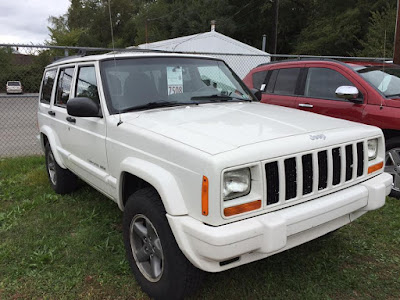 The Jeep was the "real" last Cherokee Classic. Not a Sport. Not cheap decals of the model name. A 4.0L in-line six-cylinder 4-by-4 we took off-road and used for everything. It hauled furniture, cats, trees, bikes, friends, and family.
Over the 18 years, it was like a family member. We knew it couldn't last forever, especially since moving to states with salted roads in the winter. But, we wanted it to keep running for another two or three years.
Losing the Jeep is weird. I knew how it should sound. I knew how the steering and braking should feel. I could recognize its engine when my wife drove it to and from work.
Now, it's sitting in a lot, waiting to be hauled away to an unceremonious ending. It doesn't seem fair, for some reason. Yet, it is simply a Jeep. Not a living thing.
I'll miss it, because it was familiar. It was like my grandfather's pick-up truck. Or my father's Gremlin (seriously). It's a vehicle you don't forget because it had so many memories attached.
It wasn't my first car. It wasn't my first new car. Yet, the first car (1965 Corvair) and the first new car (Geo Prism) had no deep meaning to me. The Corvair was special, because it was a family project, and I liked the car, but it wasn't easy to maintain and had plenty of issues. My wife and I also have a small compact car. It's nice. It's good. But I don't feel attached to it, despite how many years we have owned it.
The Jeep was a reliable, loyal companion. It was with us through the worst and best of times. And I do mean the worst of the worst, as well as the new starts throughout our time together.
The new vehicle is nice. But it won't be the Jeep.
 The Jeep was the "real" last Cherokee Classic. Not a Sport. Not cheap decals of the model name. A 4.0L in-line six-cylinder 4-by-4 we took off-road and used for everything. It hauled furniture, cats, trees, bikes, friends, and family.
Over the 18 years, it was like a family member. We knew it couldn't last forever, especially since moving to states with salted roads in the winter. But, we wanted it to keep running for another two or three years.
Losing the Jeep is weird. I knew how it should sound. I knew how the steering and braking should feel. I could recognize its engine when my wife drove it to and from work.
Now, it's sitting in a lot, waiting to be hauled away to an unceremonious ending. It doesn't seem fair, for some reason. Yet, it is simply a Jeep. Not a living thing.
I'll miss it, because it was familiar. It was like my grandfather's pick-up truck. Or my father's Gremlin (seriously). It's a vehicle you don't forget because it had so many memories attached.
It wasn't my first car. It wasn't my first new car. Yet, the first car (1965 Corvair) and the first new car (Geo Prism) had no deep meaning to me. The Corvair was special, because it was a family project, and I liked the car, but it wasn't easy to maintain and had plenty of issues. My wife and I also have a small compact car. It's nice. It's good. But I don't feel attached to it, despite how many years we have owned it.
The Jeep was a reliable, loyal companion. It was with us through the worst and best of times. And I do mean the worst of the worst, as well as the new starts throughout our time together.
The new vehicle is nice. But it won't be the Jeep.
Comments
Post a Comment
Comments violating the policies of this blog will not be approved for posting. Language and content should be appropriate for all readers and maintain a polite tone. Thank you.